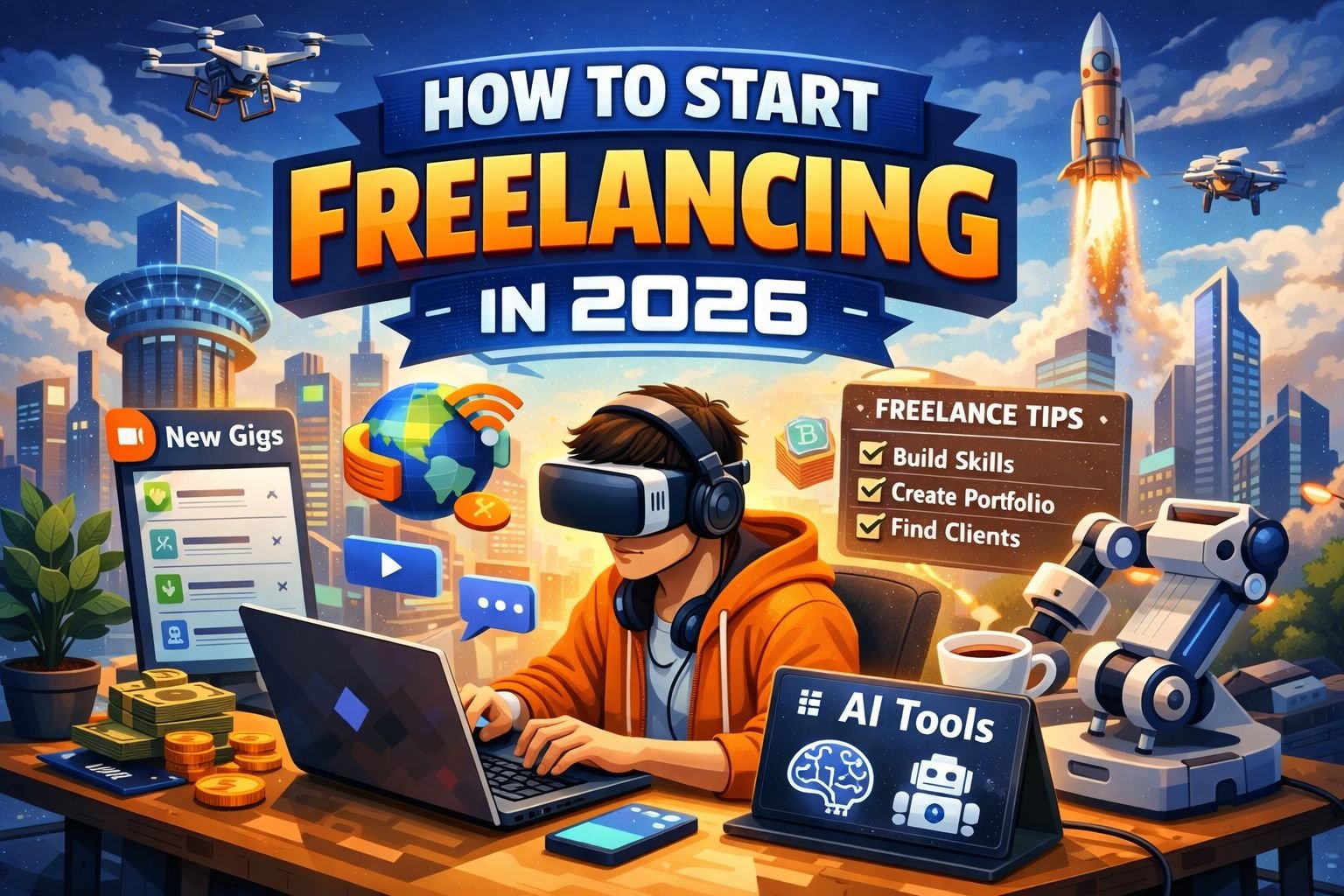
How to start freelancing means building a service-based income by offering a skill to clients online — without a fixed employer, office, or degree. In 2026, the global freelance economy has crossed $1.5 trillion, and platforms like Upwork and Fiverr connect beginners with paying clients on day one. You don’t need experience to start. You need a clear skill, a simple portfolio, and consistency.
That last part is what most guides skip.
Why 2026 Is Actually a Good Time to Start Freelancing
The numbers are real. About 48% of Fortune 500 companies now use freelance platforms, and 69% of employers hired freelancers after layoffs in 2023–2024, with over 99% planning to continue in 2026. Companies aren’t just filling gaps — they’re building entire project teams with independent talent.
The competition is also real. More freelancers means more noise. A generic profile on Upwork or a copy-pasted gig on Fiverr gets buried fast. The beginners who break through in 2026 aren’t more talented — they’re more specific about what they offer and who they offer it to.
Some people argue it’s too late to start freelancing because the market is saturated. That’s valid if you’re trying to be a generalist. A niche freelancer — someone who does “email copywriting for SaaS companies” instead of “writing services” — faces a fundamentally different, far less crowded market.
Choose One Skill (Not Five)
This is where most beginners lose a month. They research 10 skills, can’t decide, and never start.
The honest framework: pick the skill closest to something you already do, know, or genuinely find easy to learn. Then ask one question — are businesses paying for this on Upwork or Fiverr right now? If yes, that’s your starting skill.
Popular beginner-friendly options include freelance writing, graphic design, data entry, virtual assistance, and social media management. These are easy to start and require basic skills that can be developed quickly.
If you’re a student, pick something teachable — English tutoring, research assistance, or basic video editing. If you’re switching careers, pick something adjacent to your current job. A customer service worker already knows how to handle difficult clients — that’s a virtual assistant superpower.
Quick note: freelancers using AI save about 8 hours per week on average, making it possible to serve more clients without burning out. In 2026, using AI tools like ChatGPT or Canva isn’t cheating — it’s expected.
Build a Portfolio Before You Have Clients
No experience is not the same as no proof.
You can create sample work right now. Write three blog posts on topics you know. Design five social media graphics for a fake brand. Build a sample landing page. Record a 60-second explainer video. None of this requires a client — it just requires two weekends of focused effort.
Publishing even one blog post or sample piece this week helps prospective clients see real work, not just promises. A portfolio of three to five pieces beats a profile with zero samples every single time.
Or maybe I should say it this way: clients aren’t hiring your past. They’re buying confidence in your future work. Samples give them that confidence, regardless of where those samples came from.
Fiverr Pe Kaam Kaise Start Kare? Step-by-Step Guide for Beginners (2026)
Pick the Right Platform for Beginners
Freelancing websites are not all the same. The platform you choose shapes your first 90 days more than almost any other decision.
Here’s the thing: Upwork and Fiverr work differently, and beginners who understand the difference get results faster than those who treat them the same.
Quick Comparison — Best Freelance Websites for Beginners
| Platform | Best For | How It Works | Beginner Difficulty |
|---|---|---|---|
| Fiverr | Creative services, packages | You create a gig, clients find you | Low — passive discovery |
| Upwork | Writing, dev, design, VA work | You send proposals to job posts | Medium — needs strong proposals |
| Freelancer.com | Mixed skills, competitive bids | Bid on posted projects | Medium — high competition |
| Contra | Creatives, zero commission | Portfolio-first, client messaging | Low — newer, less saturated |
| PeoplePerHour | European client base | Hourly + project work | Medium |
| Toptal | Expert-level only | Rigorous screening | High — not for beginners |
How to Get Your First Job on Upwork Without Experience 2026
Fiverr for beginners: Create a gig with a specific, searchable title. Use Fiverr’s autocomplete to find real search terms. Set competitive pricing for your first 10 orders — not because your work is cheap, but because reviews unlock ranking. Your first target is to get 5-star reviews. The payments will follow.
Upwork freelancing for beginners: Start with clarity — define your service, niche, and ideal client so your positioning is clear and compelling from day one. Upwork Your Upwork profile is your landing page. Treat it like one. A focused profile that says “I write SaaS blog posts” converts better than one that says “I write anything.”
ALSO READ: Load Shedding Mein Freelancing Kaise Karein — Pakistan 2026 Survival Guide
How to Start Freelancing With No Experience
Freelancing with no experience means your first few clients are hiring your potential, not your history. The way you bridge that gap matters.
To [land your first freelancing client with no experience], follow these steps:
- Create 3–5 portfolio samples in your chosen skill area
- Write a focused profile on Upwork or create a specific gig on Fiverr
- Apply to small, clearly defined jobs — not large complex projects
- Personalize every proposal with one specific detail from the job post
- Offer your first client a small test deliverable to reduce their perceived risk
- Deliver exceptionally, then ask directly for a review
Many freelancers begin with a side hustle, taking on new projects to build their skills, client base, and confidence — without quitting their full-time job right away. Upwork This is the safest path for beginners.
Look — if you’re a student reading this, the advantage you have is time and low financial pressure. Use it. You can run your whole freelance business with ChatGPT, Canva, Fiverr, Upwork, and a couple of Chrome extensions. TalkBitz Your startup cost is essentially zero.
How to Start Freelancing as a Student
Students have a specific edge that most guides ignore: they’re already inside communities full of potential first clients — classmates, professors, university departments, local small businesses near campus.
Your first client doesn’t need to come from Upwork. It can come from a WhatsApp message to a local restaurant owner offering to manage their Instagram for Rs. 8,000 a month. One paying client who gives you a testimonial is worth more than 50 rejected Upwork proposals.
Build your student freelancing plan around three things: one skill, one platform to scale eventually, and one local or community client to start. This sequence — community first, platform second — gets beginners paid faster than jumping straight to competing with experienced sellers on Fiverr.
Pricing Your First Freelance Work
Most beginners charge too low. Then they burn out on Rs. 500 projects and quit.
The right starting price isn’t the lowest price. It’s the price that attracts clients who value the work while giving you room to deliver quality. For writing, many beginners charge $25–$75 for short posts and $75–$200 for longer articles. For design, logo gigs start at $15–$30 for beginners and scale to $100+ once you have reviews.
The pricing rule that actually works: charge what you’d feel comfortable defending in a 10-minute call with the client. If you’d feel embarrassed explaining why your service costs what it does, raise or lower accordingly.
The 30-Day Freelancing Start Plan
| Week | Action | Goal |
|---|---|---|
| Week 1 | Choose skill, create 3 portfolio samples | Have proof before you pitch |
| Week 2 | Set up Upwork profile + Fiverr gig | Be discoverable on both |
| Week 3 | Send 5 personalized proposals daily on Upwork | First response or order |
| Week 4 | Deliver first project exceptionally, ask for review | First 5-star review |
After 30 days, one review changes everything. The second client is 10 times easier than the first.
Common Mistakes Beginners Make
Trying to be on every platform at once is the fastest way to be good at none of them. Pick one. Master it. Expand later.
Pricing rock-bottom to get orders is a trap. Clients who pick purely on price are the hardest clients to work with and the least likely to leave good reviews.
Giving up after two weeks is the most common failure mode in freelancing. The first month is slow for almost everyone. That’s not a signal to quit — it’s the normal cost of building something from zero.
Final Thought
Freelancing in 2026 isn’t a shortcut to fast money. It’s a skill-building process that compounds over time. The freelancers earning $3,000–$10,000 a month didn’t get lucky — they picked one skill, showed up consistently for 90 days, and treated their first few clients like gold.
Start with one skill. Set up one profile. Send five proposals tomorrow.
That’s it. Everything else follows from those three things.
FAQs
Q: How do I start freelancing with absolutely no experience?
A: Create 3–5 portfolio samples in your chosen skill, set up an Upwork profile or Fiverr gig, and apply to small clearly defined jobs. Offer a low-risk test deliverable to your first client. Your first goal is one 5-star review — not maximum income.
Q: What’s the best freelancing website for beginners in 2026?
A: Fiverr is the easiest entry point because clients find you through search — no proposals needed. Upwork offers higher-paying work but requires strong personalized proposals. Start with Fiverr to build reviews, then expand to Upwork within 60–90 days.
Q: How do I start freelancing as a student in 2026?
A: Start with one local client from your community — a classmate’s business, a local shop, or a university department. Community clients are easier to land than platform clients and give you a testimonial faster. Use Fiverr or Upwork to scale once you have one review.
Q: Should I use Upwork or Fiverr to start freelancing?
A: Fiverr suits beginners offering packaged creative services — design, writing, editing. Upwork suits beginners offering professional services like writing, development, or virtual assistance who can write strong proposals. The key difference: Fiverr is passive discovery, Upwork is active pitching.
Q: How long does it take to earn money from freelancing as a beginner?
A: Most beginners land their first paid project within 2–4 weeks if they apply consistently. Consistent income of Rs. 20,000–50,000 per month typically takes 3–4 months of steady work, one completed review, and continuous profile improvement.


One thought on “How to Start Freelancing in 2026 – Complete Beginner’s Guide (No Experience Needed)”