The Benazir Income Support Programme (BISP) is Pakistan’s flagship social protection initiative, designed to provide financial assistance to low-income and vulnerable households. Understanding the BISP eligibility criteria in Pakistan is essential for families seeking support under this program. In this comprehensive guide, we outline the official eligibility requirements, disqualification factors, verification process, and related details to ensure complete clarity and transparency.
Overview of Benazir Income Support Programme (BISP)
The Benazir Income Support Programme was established to reduce poverty, improve social inclusion, and provide unconditional cash transfers to deserving families. The program primarily targets women-led households, ensuring financial empowerment and stability at the grassroots level.
BISP operates through a data-driven system, using the National Socio-Economic Registry (NSER) to assess household conditions and determine eligibility based on objective indicators.
Who Can Apply for BISP in Pakistan
To qualify for financial assistance, applicants must meet specific eligibility criteria defined by BISP. These criteria are strictly enforced to ensure that only deserving households receive support.
BISP Eligibility Criteria Pakistan – Key Requirements
1. Pakistani Citizenship
Applicants must be citizens of Pakistan with a valid Computerized National Identity Card (CNIC) issued by NADRA. Expired or invalid CNICs are not accepted.
2. Female Head of Household
BISP prioritizes women as beneficiaries. The applicant must be a female head of household or a responsible female member of the family registered with NADRA.
3. Poverty Score Threshold
Eligibility is determined through the NSER poverty score. Households must fall below the officially defined poverty threshold, calculated using factors such as:
- Household income
- Number of dependents
- Employment status
- Education level
- Housing conditions
Only families with a low poverty score qualify for BISP cash assistance.
4. Low Household Income
Families with no stable or sufficient source of income are eligible. This includes households where members are:
- Unemployed
- Daily wage laborers
- Domestic workers
- Informal sector workers
Government employees with fixed salaries are generally not eligible.
5. No Significant Assets
Applicants must not own valuable assets, including:
- Large agricultural land
- Commercial property
- Multiple residential properties
- Registered businesses
Ownership of such assets leads to automatic disqualification.
Disqualification Criteria for BISP
Understanding who is not eligible is equally important. The following conditions result in disqualification from BISP:
Government Employment
Any household with a member employed as:
- Federal government employee
- Provincial government employee
- Armed forces personnel
is ineligible for BISP benefits.
High Income or Tax Filers
Families that:
- File income tax returns
- Appear in FBR tax records
- Have significant bank balances
are excluded from the program.
Foreign Travel History
Households with members who have:
- Traveled abroad (excluding Hajj or Umrah in some cases)
- Held foreign visas or work permits
may be declared ineligible after verification.
Ownership of Vehicles
Ownership of cars, commercial vehicles, or heavy transport can result in disqualification. In limited cases, ownership of a motorcycle may still be acceptable.
Special Priority Groups Under BISP
BISP provides special consideration to certain vulnerable groups, including:
- Widows
- Divorced women
- Disabled individuals
- Orphans
- Elderly women with no financial support
These groups may qualify even with slightly higher poverty scores, subject to verification.
NSER Survey and BISP Eligibility Verification
National Socio-Economic Registry (NSER)
Eligibility is assessed through the NSER survey, conducted nationwide. The survey collects detailed household data, including:
- Family size
- Income sources
- Education level
- Health conditions
- Housing structure
Accurate data submission is critical, as false information can lead to permanent disqualification.
Dynamic Survey Updates
Families can update their information through BISP registration centers if their circumstances change due to:
- Job loss
- Death of an earning member
- Disability
- Natural disasters
Updated data is re-evaluated to determine continued eligibility.
How to Check BISP Eligibility Status
Applicants can verify their eligibility through official channels:
SMS Verification
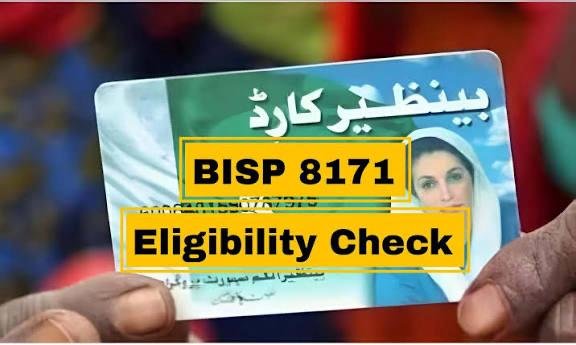
Send your CNIC number to the official BISP SMS code 8171. You will receive a message confirming your eligibility status.
BISP Registration Centers
Visit the nearest BISP Tehsil Office with:
- Original CNIC
- Family registration certificate (if required)
Officials will assist in checking and updating your eligibility status.
BISP Cash Assistance Amount
Eligible families receive quarterly financial assistance, which is periodically revised. The amount is designed to support:
- Basic household needs
- Food security
- Education and healthcare access
Payments are made through designated payment centers, banks, or biometric verification systems.
Common Reasons for Application Rejection
Applications are often rejected due to:
- Incorrect CNIC information
- Incomplete NSER data
- Mismatch with NADRA records
- Ownership of undisclosed assets
Ensuring accurate and truthful information significantly increases the chances of approval.
Reapplication and Complaint Process
Families declared ineligible can:
- File a complaint at BISP offices
- Request data re-verification
- Participate in re-surveys
BISP maintains a structured grievance redressal mechanism to address genuine cases.
Importance of Accurate Data in BISP Eligibility
BISP relies on digital data integration with NADRA, FBR, and other institutions. Even minor discrepancies can affect eligibility. We strongly emphasize:
- Keeping CNIC records updated
- Declaring correct household information
- Avoiding misinformation
Conclusion
The BISP eligibility criteria in Pakistan are designed to ensure that financial assistance reaches the most deserving families. By understanding the requirements, disqualification factors, and verification process, households can navigate the system effectively and secure much-needed support. Accurate data, timely updates, and compliance with official guidelines remain the cornerstone of successful enrollment in the Benazir Income Support Programme.